
Every day, Canadians donate clothing to their local charities in order to support a wide variety of social missions. But what happens next? Is the system working as it should? What are the biggest challenges and opportunities? Watch this recording as leaders from Bank & Vogue, the international wholesaler of secondhand goods, and the National Association for CharitableTextile Recycling (NACTR) discuss donations, exports, and the future of circular fashion.
Quick Summary
Halifax-based sustainability consultant Charlotte Genge hosted a live conversation with two leading Canadian experts in textile reuse and recycling on where donated clothing goes and why it matters.
She was joined by Tonny Colyn of NACTR and The Salvation Army, and Steven Bethell of Bank & Vogue and Beyond Remade.
Watch the webinar to find out
- The most generous thing that donors can do
- The full lifecycle of donated clothes
- The unintended consequences of brand take-back programs
- What proposed UN trade rules could mean for charities
- How donated Canadian clothing supports jobs and livelihoods around the world
Both speakers made the same case from different ends of the supply chain.
Watch the full conversation
Watch the full conversation or visit the Bank & Vogue YouTube channel to add your comments on the challenges and opportunities of secondhand clothing donations.
<YouTube embed>
Featured experts
Charlotte Genge (moderator), Principal, EnsembleCo Consulting, and Founder, The Great Swap
Tonny Colyn, President and Co-Founder, NACTR, and National Director, Business Development and Sustainability, The Salvation Army National Recycling Operations
Steven Bethell, Co-Founder, Bank & Vogue and Beyond Remade, and Board Member, Secondary Materials and Recycled Textiles Association
Treating donated clothes like a gift
Tonny’s advice for donors was simple. Wash it, remove the pet hair, and ask whether it is good enough to give to a friend. In her view, people often treat textile donations as garbage, and charities do not.
“It’s not garbage to us.”
-Tonny Colyn, The Impact of Kindness webinar
Steven added that the story does not end at the Canadian border. In markets from Kenya to Guatemala, used clothing supports livelihoods, many of them run by women.
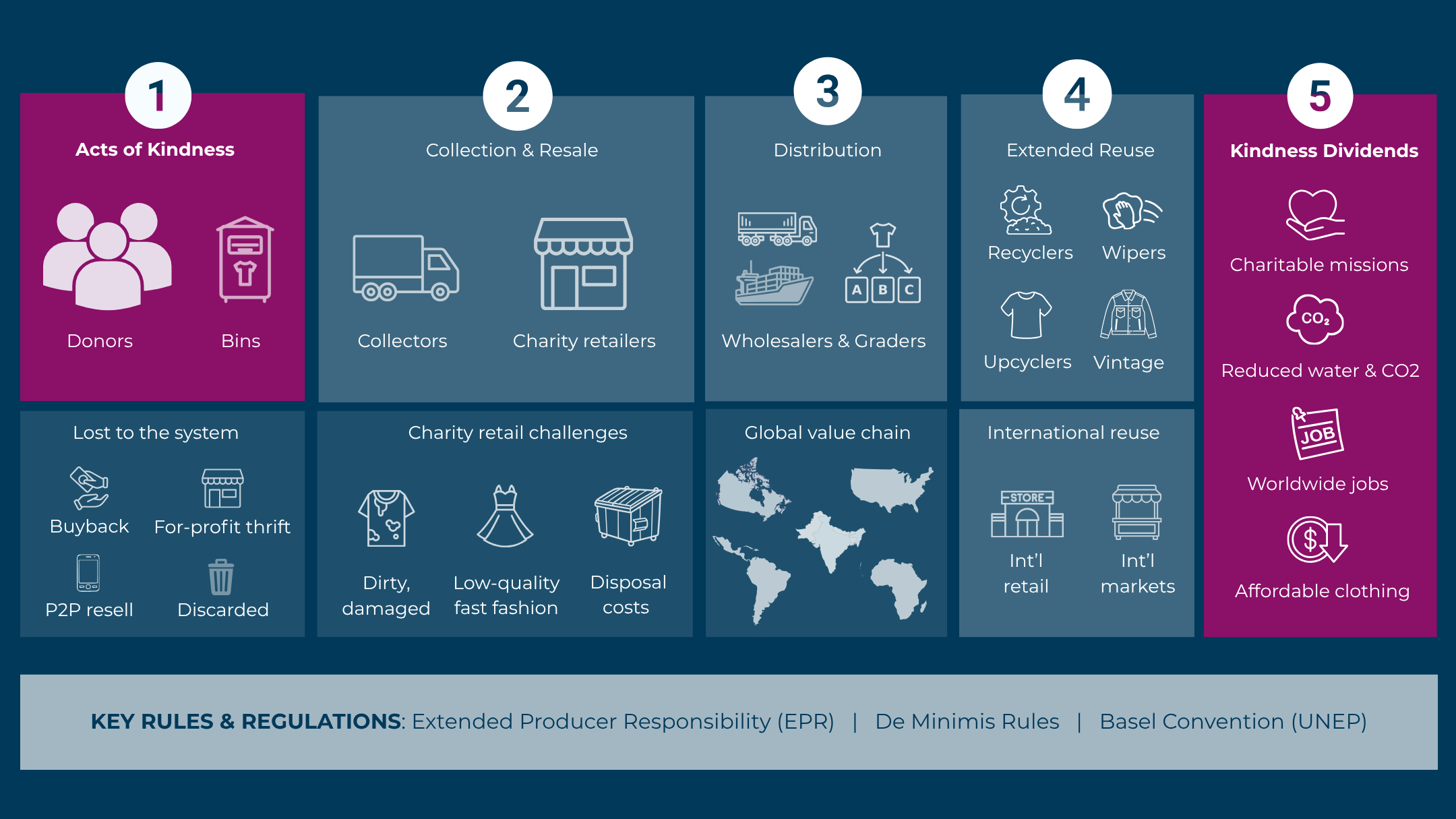
He also shared that Coach ran a life cycle assessment showing savings of up to 80% in carbon and up to 98% in water when using second generation material, and that he has seen Beyond Remade bags in Coach stores.
“Authenticity is not a trend.”
– Steven Bethell, The Impact of Kindness webinar
For both speakers, a donation’s value depends on the care it gets at every step, from a donor’s closet to a market stall in Guatemala.
Audience poll result
We asked webinar attendees, “What are the biggest challenges being faced by the textile reuse sector today?”
Half pointed to declining garment quality, which echoes Tonny’s point about caring for donations.
- Declining garment quality, 50%
- Sorting and labour costs against low resale margins, 33%
- Regulatory and trade hurdles, 17%
- Collection and repair infrastructure, 0%
- Public misconceptions about exports, 0%
What do you think? Add your comments on the YouTube video.
Audience questions
Attendees sent in questions throughout the conversation. Here are a couple that Tonny and Steven answered.
“Are you able to provide the quantity of donations that the Salvation Army sends to landfill versus textile reuse?”
Tonny said it is less than 5%, for textiles only. Almost 95% find a resale market. About half goes to Salvation Army thrift stores, and most of the rest is sold to buyers such as Bank & Vogue.
“Any concern about oversaturation of overseas markets? This happened with plastics years ago.”
Steven said the bigger problem is access. Countries such as Nigeria, South Africa, Brazil, Argentina, and China restrict imports, and bans can push trade toward smugglers.
Watch the full conversation
Watch the full discussion on the Bank & Vogue YouTube channel.
About Bank & Vogue
Bank & Vogue is a Canada-based international wholesaler of secondhand goods, with offices in 13 countries. For over 27 years, it has worked with charities across North American to find new homes for donated clothing and household items that can’t be resold locally. The company also manufactures upcycled components and circular fashion garments from post-consumer textiles for brands including Coach, Converse, Gap, and Vivienne Westwood. Learn more at bankvogue.com
About NACTR
The National Association for Charitable Textile Recycling (NACTR) gives Canadian charities that collect textiles for fundraising a united voice. Founded in 2018, its members include The Salvation Army Thrift Store, Diabetes Canada, Big Brothers Big Sisters, Goodwill, and the Developmental Disabilities Association. NACTR works with municipal, provincial, and federal governments to keep charities at the table on textile policy. Charities can learn about membership at NACTR.ca
About Charlotte Genge
Charlotte Genge is a Halifax-based textile circularity consultant who works nationally with nonprofits, NGOs, governments, and the private sector. She is Principal of EnsembleCo Consulting and Founder of The Great Swap, a community clothing swap and fair fashion event in Halifax. Learn more at ensembleco.ca