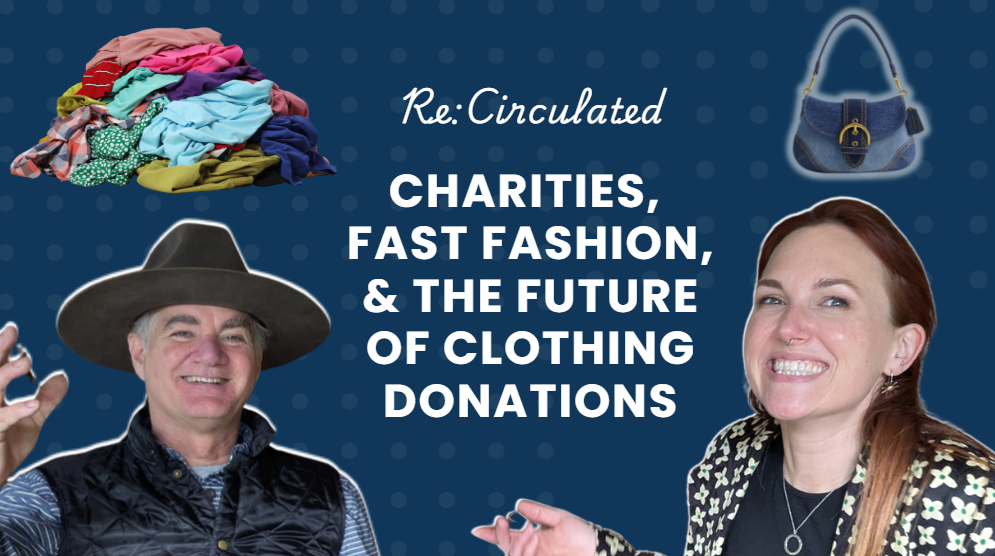

In this edition of the Re:Circulated video series, Steven Bethell, Co-Founder at Bank & Vogue, sits down with Charlotte Genge, sustainability expert and charity store advocate. They talk about the challenges faced by charity stores, trends in upcycled fashion, and the impact of the secondhand textile export trade in global markets.
Quick summary
Charity shops in North America are being squeezed from both ends, and the first episode of Re:Circulated, the video series focused on secondhand textiles and circular fashion hosted by Bank & Vogue’s Co-Founder Steven Bethell, works through what that means in practice:
- The conversation is a follow-up to the coverage by CBC’s The National on charitable clothing donations which featured from both Steven Bethell and Charlotte Genge as subject matter experts
- The CBC piece indicated that many small mid-sized charity stores in North America are having to pay to send their unsold donations to landfill, because the outlets that used to take that stock no longer need it.
- A key issue covered in Steve and Charlotte’s conversation is the challenge to charitable clothing donations caused by fast fashion, which enters Canada un-inspected and un-taxed, which differs from the de-minimis rules set in other G7 countries.
- Steven Bethell states that picking out vintage clothing items from charity store excess has gone from roughly one item in 100 just ten years ago, to one in 1,000 today
- Charlotte Genge states that open loop recycling, the turning of old textiles into insulation and other upcycled fashions, can be done now at scale with the infrastructure that already exists, while fibre-to-fibre recycling, also known as closed loop recycling, remains years away.
- The episode covers the recent circular fashion projects in collaboration with global brands including Gap, Coach, and Converse.
The full conversation is available on YouTube and spans many other hot button topics in textile reuse and recycling, including extended producer responsibility (EPR) schemes, and what shipping a container of secondhand clothing to Ghana actually costs.
Charity shops: Getting squeezed at both ends
The charity retail model has worked for over a hundred years in Canada, North America and Europe. Charities collect donated clothing, sell what they can, and use the money to fund their missions. What they cannot sell moves downstream to graders, wholesalers and export markets.
Both halves of that model are under pressure at once.
At the front door, the quality of donations is falling. People sell their best pieces themselves online, and a lot of what is produced now is not made to last through a second owner, let alone a third.
“A lot of clothes now are not designed to have a second, and third, and fourth life.” – Sustainable textile expert Charlotte Genge, speaking in the Bank & Vogue Re:Circulated video series, September 2026
Steven’s point is blunt. If a new fast fashion dress can be bought online for $8.00 delivered to the door, nobody is paying a premium for it in a charity shop, even though it probably costs the charity $10 just to get it onto the floor.
At the back door, the group of potential buyers for charity store over-stock has also thinned.
There is so much product in the system that the buyers who used to take unsold stock from smaller shops can now fill their volumes elsewhere. Those stores are not vertically integrated, so they depend on those outlets. When the outlets disappear, the stock goes to landfill at the shop’s own cost.
Charlotte expects that to show up in the numbers.
The next time a national waste characterisation study is done, she believes textiles will come in at a higher volume and as a bigger concern than the 5% – 7% of the waste stream they are usually credited with.
Open Loop vs. Closed Loop textile recycling
Much of the public conversation about textile recycling focuses on fibre-to-fibre recycling, which involves taking a garment, breaking it down to new thread, and spinning a new garment from it.
Charlotte describes that as the Closed Loop Recycling approach, and she is clear that it represents a longer-term answer to the crisis of stuff. The chemical and biochemical processes involved are still emerging and there are very few examples globally of such technology operating at scale.
In contrast, Open Loop Recycling involves taking a textile and making something else out of it entirely, like shredding denim into insulation for house builds, or cutting it up into components for use in upcycled fashion designs. The technology is not new, the infrastructure exists, and it can be used today.
In the short term, Charlotte argues, Open Loop is the way to go.
New approaches in charity store retailing

When global fashion powerhouse Tapestry, owners of Coach and other brands, ran a Life Cycle Assessment comparing existing material against new material in their upcycled fashion collaboration between Coach and Beyond Remade, the second-life material showed an 80% saving on carbon, up to 98% savings on water, and up to 68% savings on electricity.
Tapestry’s LCA Report can be downloaded free from the Beyond Remade homepage: https://www.beyondremade.com/
Something else that Steven Bethell found encouraging is not just how these top-selling accessories were made, but how they were sold.
For example, Coach marketed its upcycled bag with global celebrity icon J.Lo as a beautifully designed accessory, not as a low-carbon bag with a guilt trip attached.
Gap took a similar approach in the 2026 launch of its hugely successful Gap Bag collection, also made with upcycled components manufactured by Beyond Remade.
As Charlotte Genge points out in the video, this type of product-led messaging reaches people who might never set foot in a thrift store. It is all part of the normalization of circular fashion.
“Can we actually build a new kind of fashion industry, one that makes new products mainly from post-consumer fibre and components?” – Steven Bethell, Co-Founder, Bank & Vogue, in the Re:Circulated YouTube series, September 2026
A proposal raised by Steven for North American charities follows a similar logic.
If charity stores can start selling on the quality of what they carry, not only on price, it loosens their dependence on a donation stream that is currently flooded with un-sellable fast fashion items.
He mentions that Bank & Vogue currently sources vintage garments at scale for its European retail business, sorting through 100,000 items a day. Some of their US charity store partners are now leveraging that process to source vintage gems to augment their retail offerings.
About Re:Circulated
Re:Circulated is the YouTube series from Bank & Vogue exploring what happens to clothing and textiles after their first life. Hosted by Steven Bethell, Co-Founder, the show features a range of experts in secondhand textiles, circular fashion, and sustainability about how the global fashion industry works today, and where it can go next.
For more news and insights about the sendhand industry, textile reuse, and circular fashion, subscribe to The Rag News >>> bankvogue.com